
Vehicle Dynamics Identification and Control using Model-Structured Neural Networks
Abstract
Vehicle dynamics modeling and control are challenging due to nonlinearities, uncertainty, and the trade-off between accuracy, interpretability, and computational cost. This work presents a unified framework for vehicle identification and lateral control based on Model-Structured Neural Networks (MS-NNs), which embed physical knowledge directly into the neural architecture. A structured lateral dynamics model is derived from vehicle handling analysis and trained on high-fidelity CarMaker telemetry to predict vehicle curvature. The identified model is then used as a differentiable plant to train a neural steering controller through recurrent optimization. The approach reduces complexity while maintaining interpretability and generalization. The model achieves a curvature prediction error of about \(5\times10^{-3}\,\mathrm{m^{-1}}\), and the controller reaches a tracking error of \(1.34\times10^{-3}\,\mathrm{m^{-1}}\). Exported to ONNX and validated in closed loop within CarMaker, the controller demonstrates improved curvature tracking compared with the reference controller under the considered case-study assumptions. These results suggest that MS-NNs provide an effective framework for vehicle identification and control with limited prior knowledge and a reduced number of trainable parameters.
Model-structured neural network for lateral identification and control
The proposed framework follows a two-step approach: first, an MS-NN forward model is identified from CarMaker telemetry to predict the vehicle’s steady-state curvature; then, a neural steering controller is connected to the (frozen) forward model and trained recurrently through episodic simulation, so that the controller-plant loop approaches a unitary transfer. The forward model is inspired by the vehicle handling diagram (HD), \(\delta-\rho L\), and predicts the curvature \(\rho_{k+1}\) from a window of past steering values \(\boldsymbol\delta_k\), the current speed \(v_k\), and lateral acceleration \(a_k\), using a speed-dependent FIR filter combined with a parametric understeering function activated by triangular fuzzy membership functions — a total of 72 trainable parameters. The steering controller, with 39 trainable parameters, receives future windows of target velocity \(\mathbf{v}_{t,k}\) and curvature \(\boldsymbol{\rho}_{t,k}\) together with a past window of realized steering angles, and is trained by minimizing the error on the predicted curvature rather than directly on the steering angle, which avoids the ill-conditioning that arises near front-axle saturation.
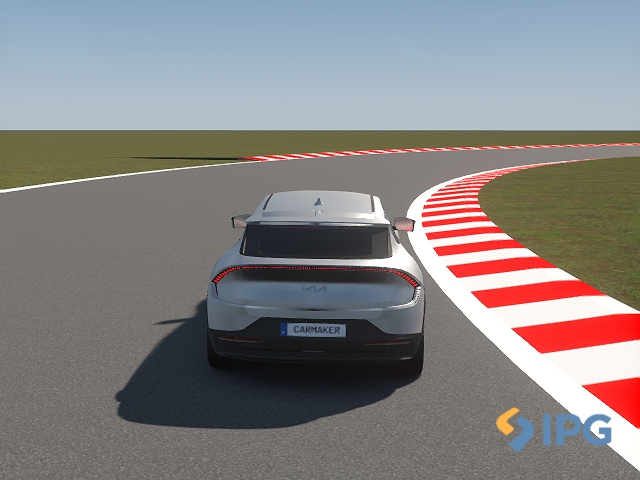
CarMaker simulation environment (Figure 1)
Figure 1 shows the CarMaker simulation environment used to generate the training and validation datasets: a high-fidelity 14-DoF electric vehicle model driven over synthetic tracks and real racing circuits such as Hockenheim, covering a wide range of curvature profiles and operating conditions up to the saturation of the front axle.
Curvature tracking error along the test track (Figure 6)
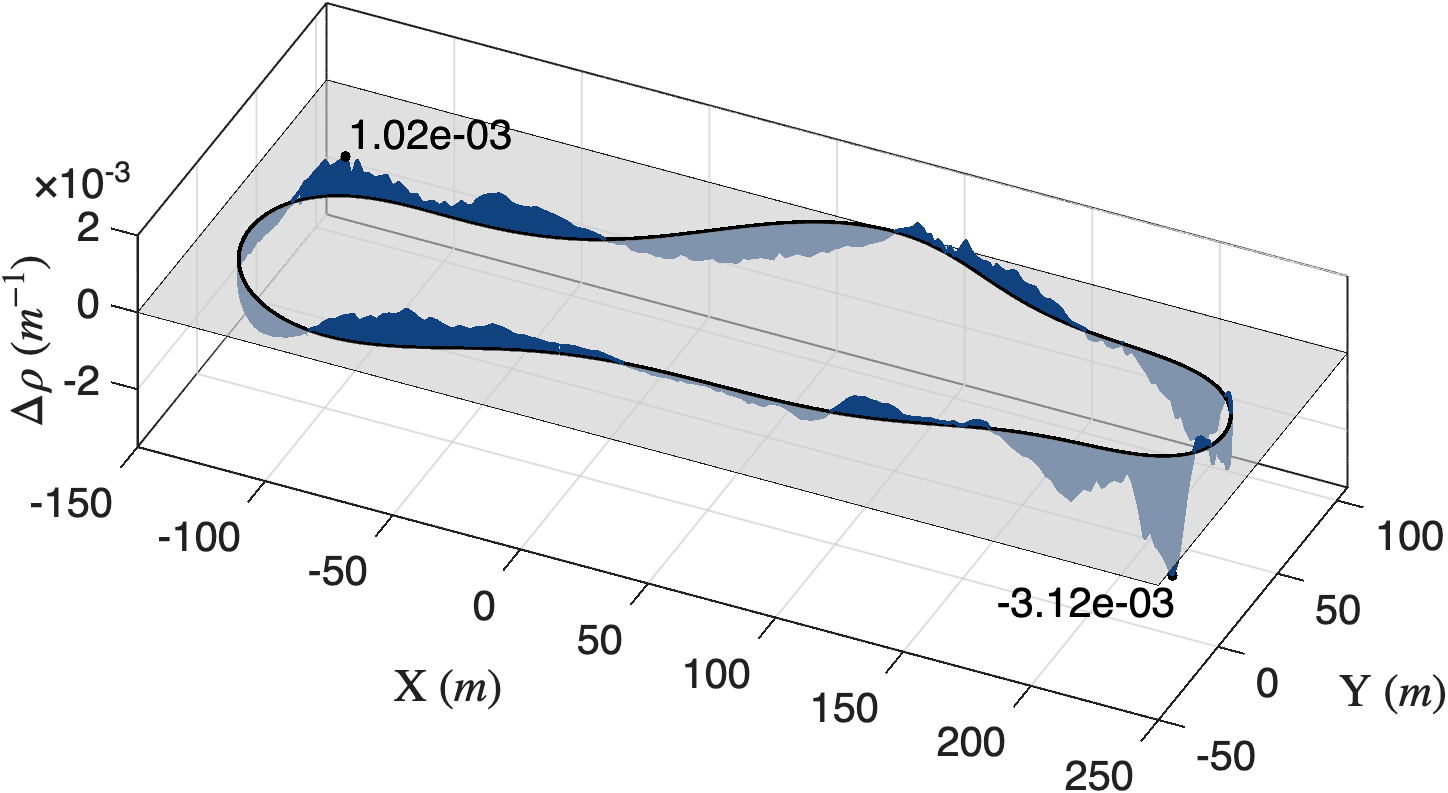
The trained controller was exported to ONNX and evaluated in closed loop within CarMaker on a dedicated test circuit, with the driver’s corner-cutting coefficient set to zero so the vehicle follows the road centerline. Figure 6 reports the resulting curvature tracking error \(\Delta\rho\) along the entire test track: the proposed neural controller achieves a curvature RMSE of \(3.4\times10^{-3}\,\mathrm{m^{-1}}\), compared with \(6.8\times10^{-3}\,\mathrm{m^{-1}}\) for the reference CarMaker controller, while requiring a more moderate steering demand.
Both the forward model and the controller are implemented and trained with the nnodely framework, which provides a modular, domain-oriented interface for designing, training, validating, and deploying model-structured neural networks.