
Vehicle Dynamics Learning From Physics Priors With Model-Structured Neural Networks
Abstract
Modeling the vehicle dynamics near the handling limits is crucial for autonomous driving and racing. However, building accurate models remains challenging due to strong nonlinearities, limited data availability, and changing environmental conditions. Physics-based models offer interpretability but require costly parameter identification, while general-purpose neural networks typically need large datasets to generalize. This paper introduces a new model-structured neural network (MS-NN-full) that learns the coupled lateral–longitudinal vehicle dynamics by embedding physical knowledge into its internal architecture. MS-NN-full combines physics-inspired neuro-fuzzy models with data-driven components to capture the quasi-steady-state and transient behavior, as well as the mutual coupling between the lateral and longitudinal dynamics. Experimental results on a 1:10-scale autonomous vehicle show that MS-NN-full outperforms existing MSNN baselines and general-purpose neural networks in accuracy and generalization, using less than two minutes of training data. The model also demonstrates rapid adaptation to new tire configurations and increased vehicle mass with minimal fine-tuning. We release our implementation and datasets to support further research in physics-guided learning for autonomous systems.
Model-structured neural network for vehicle dynamics
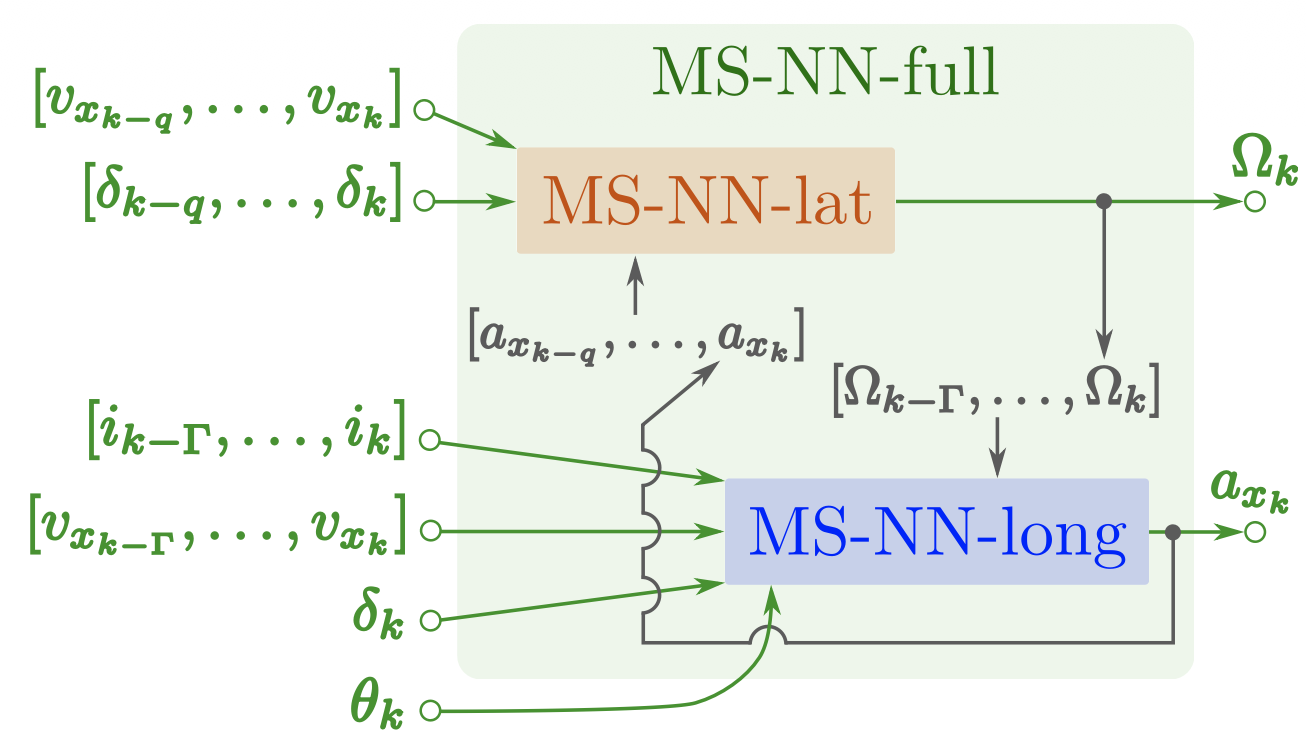
MS-NN-full learns coupled lateral–longitudinal dynamics on a RoboRacer platform. It takes windows of longitudinal speed \(v_x\), steering angle \(\delta\), motor current \(i\), and road slope \(\theta\), and predicts yaw rate \(\Omega\) and longitudinal acceleration \(a_x\). The architecture comprises two interconnected sub-networks—MS-NN-lat and MS-NN-long—trained in two stages: independent fitting of each sub-network, then fine-tuning of the closed-loop MS-NN-full. Gray signals in the full model close the loop: \(a_x\) from MS-NN-long feeds MS-NN-lat, and \(\Omega\) from MS-NN-lat feeds MS-NN-long.
MS-NN-full architecture (Figure 1)
Figure 1(a) shows the overall MS-NN-full architecture. Green arrows denote inputs (past windows of \(v_x\), \(\delta\), \(i\), and \(\theta\)) and outputs (\(\hat{\Omega}\), \(\hat{a}_x\)). Gray signals are internal variables linking MS-NN-lat (lateral) and MS-NN-long (longitudinal), capturing their mutual influence near the handling limits.
MS-NN-lat architecture (Figure 1b)
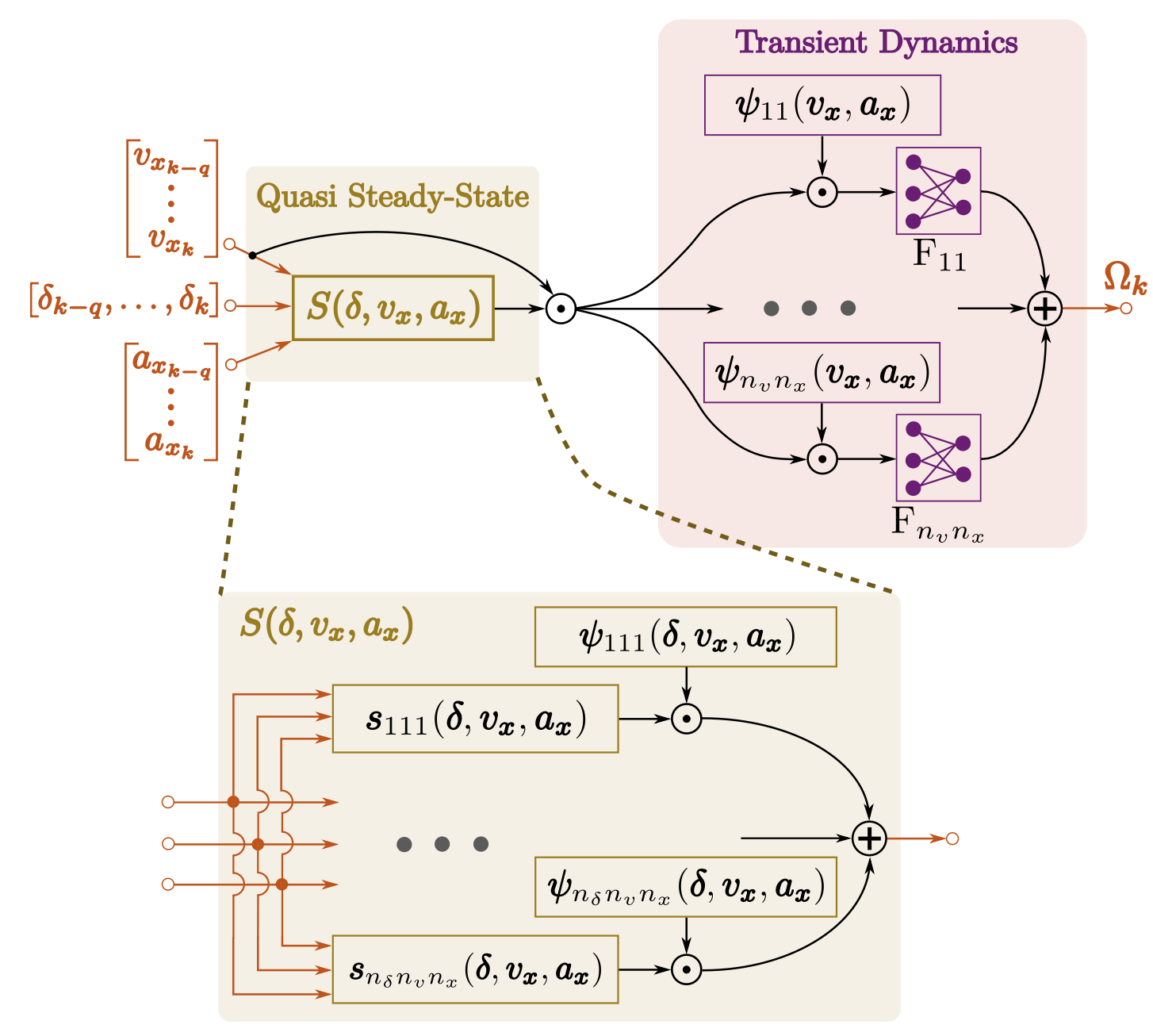
Figure 1(b) details MS-NN-lat, which learns the combined lateral vehicle dynamics. The network combines a quasi steady-state block \(S(\delta, v_x, a_x)\)—built from local neuro-fuzzy models on the handling diagram—with a transient dynamics stage. Local fully connected layers \(F_{lp}\) (purple blocks) are activated by membership functions \(\psi_{lp}(v_x, a_x)\); their outputs are blended over the input window and multiplied by \(v_{x_k}\) to obtain \(\hat{\Omega}_k\), following Eq. (5) in the paper.
MS-NN-long architecture (Figure 3)
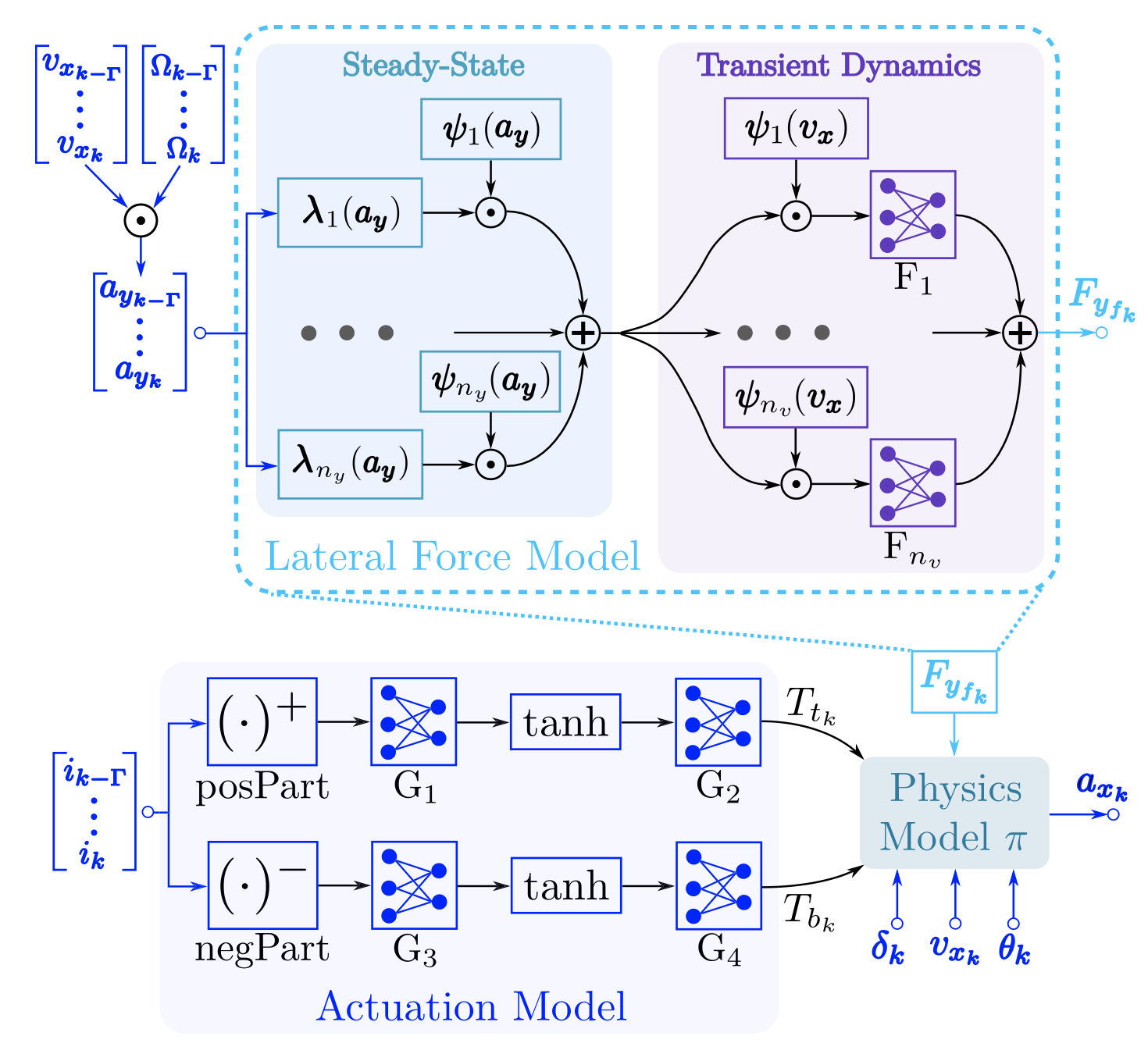
Figure 3 shows MS-NN-long, which predicts longitudinal acceleration \(\hat{a}_{x_k}\) from windows of motor current \(i\), speed \(v_x\), steering \(\delta_k\), road slope \(\theta_k\), and yaw rate \(\Omega\) (from MS-NN-lat). The architecture includes a lateral force model (steady-state and transient blocks estimating front lateral force \(F_{y_{f_k}}\)), an actuation model (neural networks \(G_1\)–\(G_4\) learning motor torque \(T_{t_k}\) and brake torque \(T_{b_k}\) from \(i_k\)), and a physics model \(\pi\) that integrates these contributions with \(\delta_k\), \(v_{x_k}\), and \(\theta_k\) to output \(\hat{a}_{x_k}\). The symbol \(\odot\) denotes the Hadamard (element-wise) product.
The MS-NN blocks are implemented with the nnodely framework for structured architectures and deployment on embedded platforms.